
Aerospace Case Study
NASA needed a machining partner capable of machining beryllium copper and other superalloys.
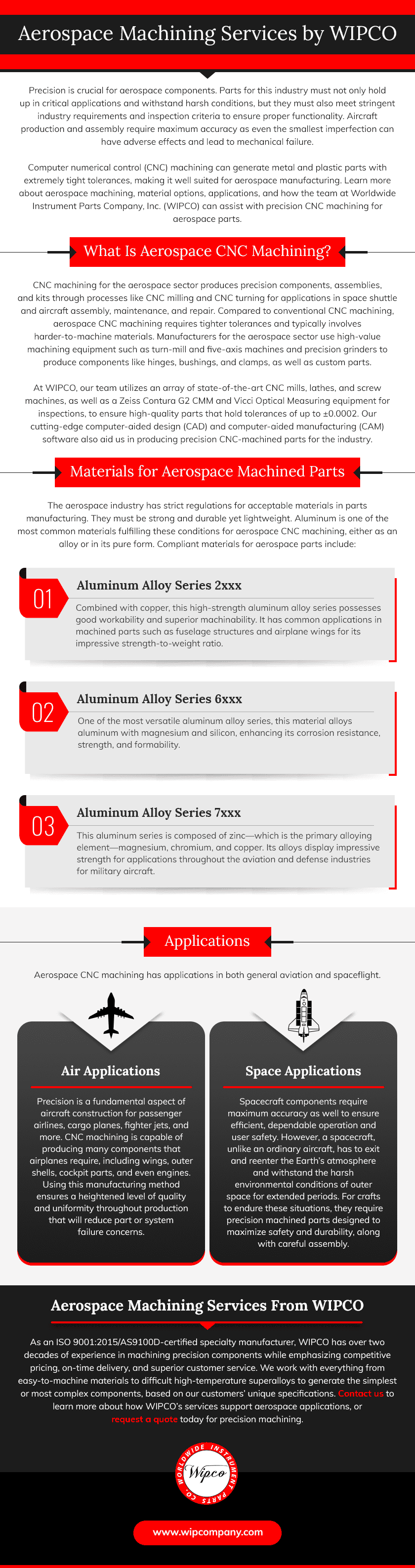 ExpandAerospace CNC machining involves producing components and parts specifically for assembling aircraft and spacecraft. The precision parts, assemblies, and kits produced with aerospace CNC machining require tighter tolerances and often involve difficult-to-machine materials—like Kovar and titanium—when compared to ordinary CNC machining. This is because aerospace parts must work properly without any risk of failure. Aerospace CNC machining can produce parts such as bushings, hinges, clamps, and other custom components.
This guide to aerospace machining will discuss the importance of CNC machining, the common materials used, the unique challenges of aerospace machining, and how Worldwide Instrument Parts Company (WIPCO) can help.
CNC machining is used across various industries to produce parts and components with a high level of precision that’s difficult to achieve with traditional manufacturing processes. One of the most critical applications of CNC machining is in the aerospace industry, where functionality, safety, and reliability are priorities. A single faulty component can lead to millions in losses as well as loss of human life.
CNC machining can meet the aerospace industry’s stringent safety standards and tight tolerance requirements. It can eliminate human error by using automation and computerization. Aerospace CNC machines are programmed on 3D computer-aided design (CAD) files that digitize the whole component production process. Aerospace manufacturers can achieve tolerances down to 0.002 mm, and state-of-the-art inspections and post-processing services ensure every part is flawless.
Depending on the aircraft component, the materials used for aerospace machining can vary. Metals, high-performance plastics, and composites are the most popular types of materials. When determining the best material for your aerospace application, consider each option’s strength, durability, weight, heat resistance, and other characteristics.
From aviation to space exploration, CNC machining benefits the aerospace industry by more than just producing high-performance parts. Aerospace CNC machining also allows research and development to excel quickly by creating and testing new concepts and making rapid revisions that would otherwise be impossible. CNC machining is used in aerospace applications throughout the design and manufacturing process of rocket ships and aircraft components to deliver the extreme precision required. CNC machining provides the accuracy needed for quality aircraft parts, from components in aviation navigation systems to landing gears to passenger planes to fighter jets.

NASA needed a machining partner capable of machining beryllium copper and other superalloys.
While CNC machining can overcome most manufacturing limitations in the aerospace industry, there are some challenges aerospace CNC machining companies must overcome to be successful.
With weight being a major factor in aircraft parts, producing lightweight components is essential. These components often contain thin webs, walls, and lattices. The high cutting force and extreme heat used in aerospace CNC machining can damage these structures and lead to part deformation.
The nature of the aerospace industry requires parts with complex geometries and very tight tolerances. Thus, companies should work with aerospace manufacturers that offer a variety of materials and processes for your needs.
Generally, in the aerospace industry, about 80% of orders arrive at their intended destination on time. However, 25% of these on-time parts do not meet quality standards. Many aerospace companies struggle with working with low-cost vendors that offer cost-effective prices and fast turnarounds but cannot deliver on these timelines with the required quality. As a result, many companies end up missing deadlines and paying more than if they had worked with higher-cost vendors in the first place.
To overcome these common aerospace machining problems, work with an aerospace manufacturer that can offer:
CNC machining is essential in the aerospace industry for meeting the high precision and safety standards required for aviation and spacecraft components.
As an ISO 9001:2015 and AS9100D certified specialty manufacturer, Worldwide Instrument Parts Company (WIPCO) produces precision-machined metal parts for the aerospace and other industries. Depending on part specifications and features, our equipment can machine parts from 0.030” to 15” in diameter and up to 35” in length, with a tolerance of ±0.0002”.
From our 15,000-square-foot climate-controlled facility, our skilled machinists use state-of-the-art CNC mills, lathes, and screw machines and advanced, up-to-date CAD/CAM software to produce exceptional parts customers expect and deserve. We specialize in working with the most difficult materials to machine, such as high-temperature superalloys. In fact, our vast experience machining superalloys is the primary reason why our customers return to us every year.
Contact us to learn more about our aerospace CNC machining services, or request a quote for your project today.
Yes. We specialize in machining Aluminum alloy series 6xxx, including 6061-T6, which is highly requested for aerospace components due to its excellent machinability and structural integrity.
Yes, our facility is fully certified to both AS9100D and ISO 9001:2015 standards. We maintain rigorous quality control, full material traceability, and continuous inspection processes required by aerospace procurement.
We are equipped for low-to-medium volume production runs. For standard aerospace components, we have the machine availability and staff to easily accommodate a capacity of 2,000 units per month or more, depending on part complexity.
Yes, our CNC machining facility is located locally in Houston, Texas. We frequently partner with local aerospace companies, offering the convenience of local site visits, quality audits, and rapid delivery.
Yes. Our CNC milling services are capable of producing parts with hard metals and other specialty materials necessary for the aerospace industry. Milling is crucial for the production of steering components and other aircraft parts. We have a variety of state-of-the-art CNC mills, including the DMG Mori DMU 50 5 Axis mill, the Haas UMC 750 5 Axis mill, and more, to produce high-quality parts for the aerospace industry.
We hold every part to the highest standards using a comprehensive, multi-stage inspection process. Certifications, material traceability, and inspection reports are available with every job. Every component passes through a documented final inspection that includes dimensional verification, surface finish checks, and any customer-specific requirements such as first-article reporting.
We have extensive experience machining a wide range of aerospace-grade materials, including titanium (Ti-6Al-4V), stainless steel (304, 316, 15-5, 17-4 PH), nickel-based superalloys (Inconel®), brass, copper, and high-performance plastics like PEEK or Torlon.
Yes. Our facility is equipped with state-of-the-art 3 and 5-axis machining centers. This allows us to produce intricate geometries, such as manifolds, housings, and engine components, with high precision and reduced setup times.
Yes. We specialize in precision machining with tolerances as tight as (pm 0.0005) inches, meeting the rigorous standards required for flight-critical components, engine pylons, and landing gear assemblies.
Yes. To ensure durability, corrosion resistance, and specific surface quality (Ra < 0.4 µm), we offer post-machining treatments including anodizing (Type II and III hardcoat), passivation, and plating, often verified through NADCAP-accredited partners.
Yes. As part of our AS9100D quality assurance process, we provide AS9102 First Article Inspection reports upon request to ensure full compliance with design specifications before high-volume production.
We support both rapid prototyping and full-scale production, often delivering production-grade components in a few weeks. We are accustomed to high-mix, low-volume schedules typical of the aerospace industry.
Yes. We maintain strict material traceability for all components. All raw materials are accompanied by manufacturer material test reports (MTRs) and certifications.
We utilize advanced Coordinate Measuring Machines (CMM) and vision inspection systems to verify part dimensions against CAD models, ensuring compliance with ISO 9001:2015 and AS9100D standards. We also have a Vicci Optical Measuring machine for dimensional inspection of turned, ground, and cylindrical components. We also provide computer generated inspection reports that are included in our certification packages for all orders.
Yes. We accept standard CAD formats, including STEP, IGES, and SolidWorks, to directly program our CNC machinery, ensuring accuracy from design to production.
We follow strict aerospace packaging standards to ensure parts arrive damage-free and contamination-free. Components are carefully cleaned, individually wrapped, and protected using anti-static materials, foam inserts, or custom crates as needed. For sensitive or flight-critical parts, we offer vacuum sealing, moisture barrier bags, and desiccant packaging in accordance with customer and industry specifications.
We supply comprehensive documentation packages to meet aerospace compliance requirements. This can include Certificates of Conformance (CoC), material certifications (MTRs), First Article Inspection (FAI) reports per AS9102, inspection reports, and any required special process certifications. All paperwork is fully traceable and aligned with AS9100D and ISO 9001:2015 standards.
We provide a wide range of aerospace-grade surface finishes to meet both functional and cosmetic requirements. This includes precision-machined finishes (as low as Ra < 0.4 µm), bead blasting, polishing, anodizing (Type II and Type III hardcoat), passivation, chemical film (Alodine), and various plating options. All finishing processes are tightly controlled and can be performed through approved or NADCAP-accredited partners when required.