
Precision is crucial for aerospace components. Parts for this industry must not only hold up in critical applications and withstand harsh conditions, but they must also meet stringent industry requirements and inspection criteria to ensure proper functionality. Aircraft production and assembly require maximum accuracy as even the smallest imperfection can have adverse effects and lead to mechanical failure.
Computer numerical control (CNC) machining can generate metal and plastic parts with extremely tight tolerances, making it well suited for aerospace manufacturing. Learn more about aerospace machining, material options, applications, and how the team at Worldwide Instrument Parts Company, Inc. (WIPCO) can assist with precision CNC machining for aerospace parts.
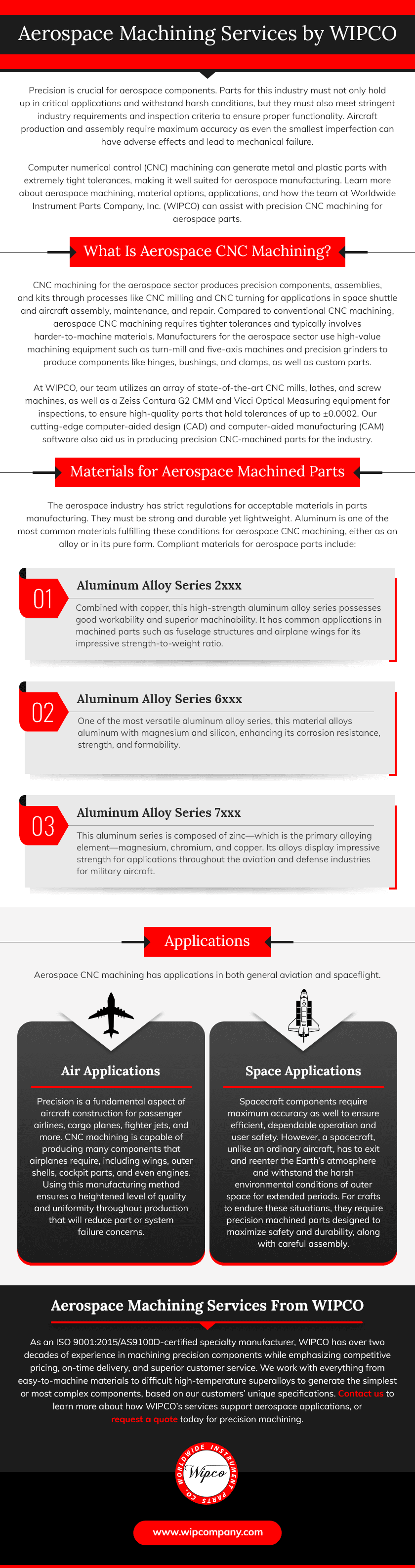 What Is Aerospace CNC Machining?
CNC machining for the aerospace sector produces precision components, assemblies, and kits through processes like CNC milling and CNC turning for applications in space shuttle and aircraft assembly, maintenance, and repair. Compared to conventional CNC machining, aerospace CNC machining requires tighter tolerances and typically involves harder-to-machine materials. Manufacturers for the aerospace sector use high-value machining equipment such as turn-mill and five-axis machines and precision grinders to produce components like hinges, bushings, and clamps, as well as custom parts.
At WIPCO, our team utilizes an array of state-of-the-art CNC mills, lathes, and screw machines, as well as a Zeiss Contura G2 CMM and Vicci Optical Measuring equipment for inspections, to ensure high-quality parts that hold tolerances of up to ±0.0002. Our cutting-edge computer-aided design (CAD) and computer-aided manufacturing (CAM) software also aid us in producing precision CNC-machined parts for the industry.
Materials for Aerospace Machined Parts
The aerospace industry has strict regulations for acceptable materials in parts manufacturing. They must be strong and durable yet lightweight. Aluminum is one of the most common materials fulfilling these conditions for aerospace CNC machining, either as an alloy or in its pure form. Compliant materials for aerospace parts include:
- Aluminum Alloy Series 2xxx. Combined with copper, this high-strength aluminum alloy series possesses good workability and superior machinability. It has common applications in machined parts such as fuselage structures and airplane wings for its impressive strength-to-weight ratio.
- Aluminum Alloy Series 6xxx. One of the most versatile aluminum alloy series, this material alloys aluminum with magnesium and silicon, enhancing its corrosion resistance, strength, and formability.
- Aluminum Alloy Series 7xxx. This aluminum series is composed of zinc—which is the primary alloying element—magnesium, chromium, and copper. Its alloys display impressive strength for applications throughout the aviation and defense industries for military aircraft.
Applications
Aerospace CNC machining has applications in both general aviation and spaceflight.
Air Applications
Precision is a fundamental aspect of aircraft construction for passenger airlines, cargo planes, fighter jets, and more. CNC machining is capable of producing many components that airplanes require, including wings, outer shells, cockpit parts, and even engines. Using this manufacturing method ensures a heightened level of quality and uniformity throughout production that will reduce part or system failure concerns.
Space Applications
Spacecraft components require maximum accuracy as well to ensure efficient, dependable operation and user safety. However, a spacecraft, unlike an ordinary aircraft, has to exit and reenter the Earth’s atmosphere and withstand the harsh environmental conditions of outer space for extended periods. For crafts to endure these situations, they require precision machined parts designed to maximize safety and durability, along with careful assembly.

Aerospace Case Study
NASA needed a machining partner capable of machining beryllium copper and other superalloys.
Aerospace Machining Services From WIPCO
As an ISO 9001:2015/AS9100D-certified specialty manufacturer, WIPCO has over two decades of experience in machining precision components while emphasizing competitive pricing, on-time delivery, and superior customer service. We work with everything from easy-to-machine materials to difficult high-temperature superalloys to generate the simplest or most complex components, based on our customers’ unique specifications. Contact us to learn more about how WIPCO’s services support aerospace applications, or request a quote today for precision machining.
The Complete Guide to Aerospace Machining Materials
In this free guide, we’ll discuss the characteristics of aerospace
materials and the applications they’re used in.
Aerospace machining creates durable, precise components according to stringent industry requirements. From the metal outer shell of an aircraft to highly intricate small parts, this manufacturing technique helps turn blueprints into expertly constructed finished products. At WIPCO, we work with a number of materials that perform reliably in aerospace applications, including aluminum, titanium, and exotic alloys. In this guide, we’ll discuss the characteristics of aerospace materials and the applications they’re used in.
Aerospace Machining Services FAQ’s
Can you handle CNC machining for Aluminum alloy series 6xxx?
Yes. We specialize in machining Aluminum alloy series 6xxx, including 6061-T6, which is highly requested for aerospace components due to its excellent machinability and structural integrity.
Do you hold AS9100D and ISO 9001:2015 certifications?
Yes, our facility is fully certified to both AS9100D and ISO 9001:2015 standards. We maintain rigorous quality control, full material traceability, and continuous inspection processes required by aerospace procurement.
What is your monthly production capacity for CNC machined parts?
We are equipped for low-to-medium volume production runs. For standard aerospace components, we have the machine availability and staff to easily accommodate a capacity of 2,000 units per month or more, depending on part complexity.
Are you located near Houston, Texas?
Yes, our CNC machining facility is located locally in Houston, Texas. We frequently partner with local aerospace companies, offering the convenience of local site visits, quality audits, and rapid delivery.
Can you do CNC milling on hard and other specialty materials used in Aerospace?
Yes. Our CNC milling services are capable of producing parts with hard metals and other specialty materials necessary for the aerospace industry. Milling is crucial for the production of steering components and other aircraft parts. We have a variety of state-of-the-art CNC mills, including the DMG Mori DMU 50 5 Axis mill, the Haas UMC 750 5 Axis mill, and more, to produce high-quality parts for the aerospace industry.
What is your quality assurance process?
We hold every part to the highest standards using a comprehensive, multi-stage inspection process. Certifications, material traceability, and inspection reports are available with every job. Every component passes through a documented final inspection that includes dimensional verification, surface finish checks, and any customer-specific requirements such as first-article reporting.
What aerospace materials can you machine besides aluminum?
We have extensive experience machining a wide range of aerospace-grade materials, including titanium (Ti-6Al-4V), stainless steel (304, 316, 15-5, 17-4 PH), nickel-based superalloys (Inconel®), brass, copper, and high-performance plastics like PEEK or Torlon.
Do you offer 5-axis CNC milling for complex aerospace parts?
Yes. Our facility is equipped with state-of-the-art 3 and 5-axis machining centers. This allows us to produce intricate geometries, such as manifolds, housings, and engine components, with high precision and reduced setup times.
Can you handle tight tolerance requirements?
Yes. We specialize in precision machining with tolerances as tight as (pm 0.0005) inches, meeting the rigorous standards required for flight-critical components, engine pylons, and landing gear assemblies.
Do you provide post-machining processes like anodizing or coating?
Yes. To ensure durability, corrosion resistance, and specific surface quality (Ra < 0.4 µm), we offer post-machining treatments including anodizing (Type II and III hardcoat), passivation, and plating, often verified through NADCAP-accredited partners.
Can you handle First Article Inspection (FAI) reports?
Yes. As part of our AS9100D quality assurance process, we provide AS9102 First Article Inspection reports upon request to ensure full compliance with design specifications before high-volume production.
What are your typical lead times for prototypes vs. production?
We support both rapid prototyping and full-scale production, often delivering production-grade components in a few weeks. We are accustomed to high-mix, low-volume schedules typical of the aerospace industry.
Do you offer material traceability?
Yes. We maintain strict material traceability for all components. All raw materials are accompanied by manufacturer material test reports (MTRs) and certifications.
What inspection technology do you use?
We utilize advanced Coordinate Measuring Machines (CMM) and vision inspection systems to verify part dimensions against CAD models, ensuring compliance with ISO 9001:2015 and AS9100D standards. We also have a Vicci Optical Measuring machine for dimensional inspection of turned, ground, and cylindrical components. We also provide computer generated inspection reports that are included in our certification packages for all orders.
Do you accept CAD files directly?
Yes. We accept standard CAD formats, including STEP, IGES, and SolidWorks, to directly program our CNC machinery, ensuring accuracy from design to production.
How do you package aerospace components for shipment?
We follow strict aerospace packaging standards to ensure parts arrive damage-free and contamination-free. Components are carefully cleaned, individually wrapped, and protected using anti-static materials, foam inserts, or custom crates as needed. For sensitive or flight-critical parts, we offer vacuum sealing, moisture barrier bags, and desiccant packaging in accordance with customer and industry specifications.
What documentation and certifications do you provide with each order?
We supply comprehensive documentation packages to meet aerospace compliance requirements. This can include Certificates of Conformance (CoC), material certifications (MTRs), First Article Inspection (FAI) reports per AS9102, inspection reports, and any required special process certifications. All paperwork is fully traceable and aligned with AS9100D and ISO 9001:2015 standards.
What surface finishes can you achieve for aerospace components?
We provide a wide range of aerospace-grade surface finishes to meet both functional and cosmetic requirements. This includes precision-machined finishes (as low as Ra < 0.4 µm), bead blasting, polishing, anodizing (Type II and Type III hardcoat), passivation, chemical film (Alodine), and various plating options. All finishing processes are tightly controlled and can be performed through approved or NADCAP-accredited partners when required.